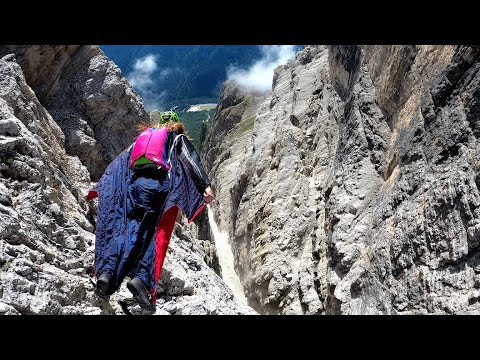
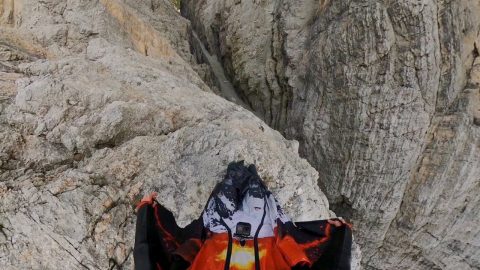
Sassongher – Dolomites, Italy
In the world of extreme proximity flying, some lines are spoken about casually, others with admiration. A very small few are discussed quietly, with long pauses and careful words. Wingsuiting the Death Star falls firmly into that last category.
Carved into the sheer limestone of the Italian Dolomites, the Death Star is not a single jump but a mindset — one that represents absolute commitment, precision flying, and consequences that leave no room for error.
What Is the Death Star?
The Death Star refers to a highly technical wingsuit proximity line on Sassongher, a towering peak overlooking Val Badia. While Sassongher stands at roughly 8,700 feet (2,665 meters), its reputation comes not from height, but from the geometry of its north face.
The line funnels pilots into a narrow, steep, concave channel of rock where speed builds instantly and terrain rushes past at arm’s length. Once committed, there are no clean escape options — the flight must be flown perfectly from start to finish.
Why It’s Called “The Death Star”
The nickname is widely believed to be inspired by Star Wars: Episode IV – A New Hope, specifically the trench run scene where Luke Skywalker threads a high-speed, no-margin channel with disaster waiting on both sides.
The comparison fits uncomfortably well:
-
A narrow trench of unforgiving walls
-
Extreme speed and commitment
-
No margin for course correction
-
A single, irreversible line
Among wingsuit pilots, the name stuck — not as bravado, but as shorthand for how serious this line really is.
What Makes Wingsuiting the Death Star So Dangerous
Several factors combine to make this one of the most intimidating proximity flights in the Alps:
1. Minimal Exit Margin
Acceleration begins immediately. There is little time to stabilize or correct heading before terrain closes in.
2. Complex Airflow
The Dolomites are notorious for unpredictable winds. Rotor, compression, and thermal effects can change rapidly along the face, even during the same flight window.
3. Visual Compression
The concave rock walls distort depth perception. Pilots often describe the sensation of the mountain “pulling them in,” demanding constant micro-corrections.
4. No Bailout Options
Unlike many lines, there is no safe “out.” Once in, the only way forward is through.
Reputation Within the Wingsuit Community
Wingsuiting the Death Star is never considered a progression jump. It is typically attempted only by pilots with:
-
Hundreds to thousands of wingsuit BASE jumps
-
Extensive Dolomites experience
-
Deep familiarity with proximity flight psychology
Even then, many elite pilots choose never to fly it. Those who do rarely speak about it casually — and almost never encourage others to follow.
Terrain Geometry: Why Sassongher Is Different
The north face of Sassongher above Val Badia presents a combination that pilots immediately recognize as hostile:
-
Concave limestone structure that visually compresses distance
-
A funneling profile that accelerates perceived ground rush
-
Minimal lateral terrain relief once established in the line
Unlike longer alpine proximity routes that offer micro-outs or widening geometry lower on the face, the Death Star remains geometrically closed almost immediately after exit.
Once inside the channel, heading corrections must be anticipatory, not reactive.
Exit Dynamics and Early Flight Phase
The exit defines the entire flight.
-
Immediate speed build: There is no neutral glide phase.
-
Heading lock-in occurs early; late alignment corrections compound rapidly.
-
Minimal time-to-stability before terrain proximity becomes critical.
Pilots describe the first seconds as the highest cognitive load — a brief window where instability can still be corrected, followed by a phase where the line is simply flown.
Airflow Considerations
Sassongher’s reputation is as much about air as it is about rock.
-
Localized rotor near the face under certain synoptic wind directions
-
Thermal interference from adjacent sun-exposed walls
-
Compression effects within the channel, especially under higher wind components
Conditions that appear acceptable from launch or valley observation can change abruptly once committed. This makes conservative go/no-go thresholds essential — and often decisive.
Visual Perception and Cognitive Load
The concave wall geometry produces a well-known effect:
-
False sense of increased clearance
-
Rapid loss of depth cues
-
Accelerated visual flow rate
This combination can induce overconfidence early and decision paralysis late. Pilots familiar with the line emphasize that the Death Star punishes hesitation as severely as aggression.
Equipment and Suit Considerations
While specific configurations vary, pilots generally favor:
-
Predictable pressurization over maximum glide
-
Strong pitch authority at high speed
-
Familiar, well-flown equipment — not experimental setups
This is not a line where marginal gains outweigh known handling characteristics.
Community Perspective: Why Few Fly It
Among elite wingsuit pilots, Wingsuiting the Death Star is not considered a logical progression step. It is often described as:
-
A culmination line, not a training objective
-
Highly condition-dependent
-
Psychologically demanding even for experienced proximity flyers
Many respected pilots consciously choose not to fly Sassongher, viewing restraint as a mark of sound judgment rather than limitation.