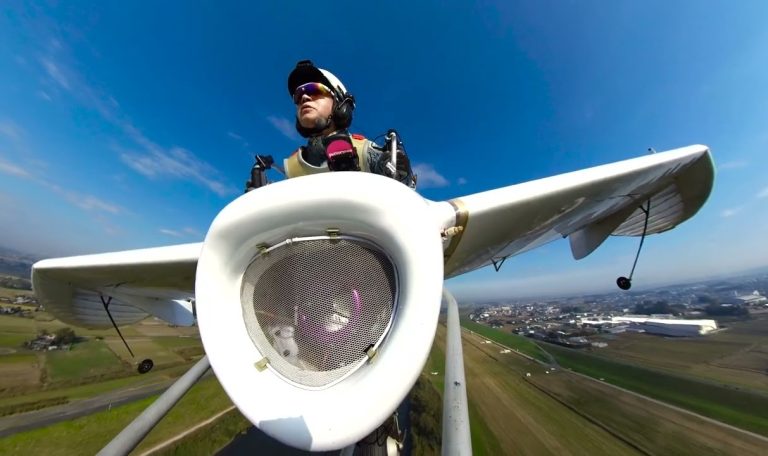
SEKIYADO, JAPAN (November 2025) — One of the most unusual aircraft in sport aviation — the OpenSky M-02J, a jet-powered, tailless “personal glider” inspired by Nausicaä of the Valley of the Wind — completed another round of test flights at Sekiyado Gliding Field in Japan.
Footage recorded as the second flight on November 8, 2025 shows the aircraft accelerating down the field and lifting off in its unmistakable birdlike silhouette — instantly recognizable as the closest real-world cousin to the fictional Mehve.
What happened at Sekiyado
The flight is directly tied to posts from OpenSky creator Kazuhiko Hachiya, who referenced the Nov. 8, 2025 Sekiyado test flight footage as part of the aircraft’s ongoing operations there.
Later comments from Hachiya added extra significance: he described the aircraft continuing to fly at Sekiyado for skills maintenance and noted that 2025 would likely be his final year piloting the M-02J himself.
In the same period, Japanese aviation site FlyTeam reported that public viewing of the aircraft was expected during Noda City’s “Sora Matsuri 2025” festival on Nov. 16, 2025, also at Sekiyado.
The aircraft: OpenSky M-02J
The OpenSky M-02J is not a hang glider and not a conventional ultralight airplane. It’s best described as an experimental jet-powered motor glider, designed around minimalist structure and an unconventional control feel that blends glider stability with pilot body input.
The project is led by Japanese inventor/artist Kazuhiko Hachiya, designed with Satoru Shinohe, with aircraft manufacturing/build support from Aircraft Olympos.
How it’s controlled (weight shift meets aerodynamic control)
Aircraft Olympos describes the control philosophy like this:
-
Pitch (nose up/down): controlled by weight shift (pilot body movement)
-
Roll (bank): controlled through a mechanism linking the pilot’s hammock/harness to aileron movement
-
Yaw behavior: follows naturally from roll, supported by wing-mounted fins
That hybrid approach is why the aircraft seems to “float” and bank like a living creature rather than a conventional airplane.
Confirmed M-02J specs (imperial)
Unlike many viral aircraft, the M-02J has published specifications — including engine and thrust.
From the OpenSky project documentation:
-
Crew: 1
-
Pilot + gear weight limit: under 139 lb (63 kg)
-
Length: 8 ft 9 in (2.67 m)
-
Wingspan: 31 ft 7 in (9.63 m)
-
Height: 4 ft 6 in (1.36 m)
-
Wing area: 131 sq ft (12.2 m²)
-
Empty weight (dry): 220 lb (100 kg)
-
Max takeoff weight: 397 lb (180 kg)
-
Engine: AMT Netherlands “NIKE” turbojet
-
Maximum thrust: 176 lbf (80 kgf)
That’s an eye-catching ratio of thrust-to-weight for any sport aircraft, and it helps explain the short, punchy takeoff style captured in the Sekiyado footage.
Kitplanes also confirms the AMT NIKE turbojet producing 176 pounds of thrust and describes the aircraft’s development path through Japan’s experimental aviation environment.
The engine evolution: 66 lb thrust → 88 lb thrust → 176 lb thrust
One Japanese technical write-up describes how the project steadily upgraded engines over time:
-
Aviation Design T-340 turbine (~66 lbf thrust) — used through about 2010
-
AMT Titan turbojet (~88 lbf thrust) — used roughly 2012–2014
-
AMT Nike turbojet (~176 lbf thrust) — used from around 2015 onward
A further note from Japanese Wikipedia adds that, in more recent operation, thrust has reportedly been limited by ECU programming, stated around 143 lbf (about 65 kgf).
Performance numbers (reported)
Typical performance figures reported for the M-02J include:
-
Maximum level speed: about 69 mph (111 km/h)
-
Takeoff run: around 262 ft (80 m)
-
Mission profile: short powered flight, then glider-like flight behavior
Why this Sekiyado flight matters
By 2025, the OpenSky aircraft had already progressed beyond a novelty and into a globally recognized experimental design — including international attention at major aviation events such as EAA AirVenture Oshkosh.
So Hachiya’s comment about stepping away from piloting after 2025 gives the November Sekiyado flights extra meaning: these aren’t just routine tests — they may represent the closing chapter of the aircraft’s most personal era.
The bottom line
The OpenSky M-02J isn’t just a viral clip — it’s a real, flying experimental aircraft with published specifications, a documented engine evolution, and a flight-control philosophy unlike anything else in recreational aviation.
And with the creator signaling 2025 may be his final year at the controls, the November Sekiyado test flights may be among the last times the world sees this “real Mehve” flown by the person who imagined it into existence.